Showing posts with label Hong Kong. Show all posts

Sunday, January 24, 2010

New, remarkable animation video of the Po Shan Road landslide in Hong Kong

Thanks to David Kwok of the Geotechnical Engineering Office in Hong Kong for highlighting this video to me, and for the image below.

On 18th June 1972 Hong Kong suffered an extraordinary landslide at Po Shan Road, in the Mid-Levels area:


The slide, which had a volume of about 40,000 cubic metres, induced the collapse of two large buildings, killing 67 people and injuring a further 20. The landslide understandably caused considerably soul-searching within Hong Kong, not least because major stability problems at the site had been identified nine months before the failure. A recommendation of the Royal Commission (Hong Kong was a British dependency at that time of course) was that a government agency should be established to manage slopes. This led to the formation of what is now called the Geotechnical Engineering Office (GEO), which has worked tirelessly and with considerable success to reduce landslide losses in Hong Kong.

In 2007 as part of its 30th anniversary celebrations, GEO produced this brochure. Much more information about their work, and about slope issues in Hong Kong, can be found on their slope safety website. There is little doubt that the approach has been successful (and should be repeated elsewhere - for example in Taiwan). This graph, taken from the brochure above, shows the trends in landslide losses before and after the establishment of GEO:


However, through all of their work they have not forgotten the importance of the Po Shan Road incident. Recently, they have produced a short video describing the event. Most interesting is a set of animations of the occurrence of the landslide, including its impact on the buildings. This is an impressive and useful illustration of the destructive power of even comparatively small landslides when they occur in urbanised areas, and of the need to maintain vigilance.

The video is available from the GEO download site at the following address:

http://hkss.cedd.gov.hk/hkss/eng/download/poshan_incident_english.wmv

I have embedded the video here - you should be able to play it by clicking on the video screen below:


Do take a look - it is well worth it - and download the original from the GEO download site.

Tuesday, October 21, 2008

Sichuan Earthquake session at SinoRock 2009

Prof. ZuYu Chen has today emailed to bring to my attention a special conference session on the geohazards associated with the Wenchuan Earthquake. This will be held at the SinoRock 2009 conference in Hong Kong on 22nd May 2009. It will be followed by a field trip to the earthquake zone.

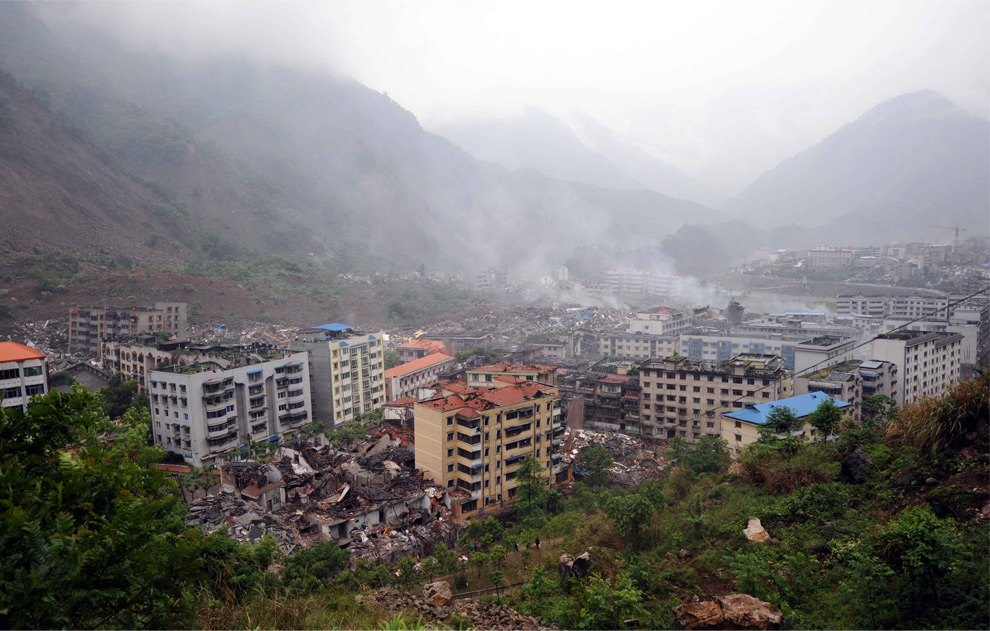
Beichuan New Town landslide. Source: This is Life Blog

Papers are due by 15th January 2009. Details of the session are available here.

Wednesday, June 11, 2008

Debris flow video from Hong Kong

Thanks to a former student for bringing the following video to my attention. Hopefully it will play directly when you click on the box below - if not then take a look at:
http://www.youtube.com/watch?v=R2uTKyK1c9k


This channelised debris flow occurred on Lantau Island, near to Hong Kong airport, on 7th June when the area was affected by an exceptional ("black") rainfall event. In a single hour Hong Kong observatory recorded 140 mm of rain, the highest intensity on record there. During the day, which saw over 300 mm of rain across most of the area, about 400 landslides were triggered on Lantau alone, including one that killed two people.

Helpfully, the Hong Kong Observatory make rainfall isohyet charts available online. I have annotated below the map for 7th June and the approximate location of the landslide. Note that the landslide occurred in an area in which rainfall totals were at their highest (>400 mm).

Hong Kong Observatory isohyet map of the rainfall distribution for 7th June 2008. The approximate location of the landslide in the Youtube video is indicated.

A couple of words about the landslide. This is technically a channelised debris flow. It appears to have started as a comparatively small shallow slip in weathered materials high on the slope. The mobile material has then picked up (technically this is termed "entrained") debris and water in the channel. Once such flows start, and assuming that they have a steepish slope to travel down, they build momentum and volume to create a highly turbulent and destructive pulse of material that moves very rapidly. Slides of this type typically occur in pulses, as can be seen in the video, which is of course particularly nasty for people in the way. Needless to say these types of flow are very dangerous, particularly if they overflow the channel banks. Fortunately, in this case the flow appears to have remained mostly in the channel itself.

Hong Kong has a long history of these types of landslides, and is adept at managing them. To enhance this the Hong Kong government has just started a large project to identify natural terrain areas prone to these failures and to mitigate areas of high risk.