Showing posts with label earthquake conference. Show all posts

Friday, January 15, 2010

Why the Haiti earthquake takes us into new territory for disaster response

The Haiti earthquake rightly continues to dominate the news around the world, with the situation on the ground looking increasingly desperate. The news media are already reporting on the growing frustration amongst the population about the lack of aid, not uncommon in large disasters actually, but probably magnified in this case. Although every rapid onset disaster is different, in a number of ways this event takes us into new territory. This will make the short, medium and long term mitigation of this event very difficult. These are the key issues as I see them:

1. Haiti has no army - and therefore effectively no national capacity to deal with the immediate aftermath
In recent years we have seen large earthquakes in other less developed countries - Kashmir in 2005 and Sichuan in 2008 spring to mind. In both cases, as is generally the case, the immediate response is framed by the national army, who undertake the initial rescue and logistics operations, followed quickly by the international organisations and agencies. Once the immediate rescue phase is over the army usually plays a key role in co-ordinating the response, in particular with the logistics of getting medical aid, food, water and sanitation to the people who need it. Haiti has no army - the military was demobilised in 1995. This is a key factor in the lack of coordination that you can see in the television pictures.

2. The earthquake struck the capital city
Point 1 is hugely exacerbated by what was in effect a direct hit on the capital city. It is clear that many government buildings collapsed and many civil servants were killed. In addition many of the key staff from international agencies were also killed. In a moment a huge component of the in-country organisational capacity was destroyed. This was not the case in other comparable disasters, where the national capability remained intact.

3. Population concentration is a key issue
The earthquake has struck a very densely populated urban area. Port-au-Prince is a natural amphitheatre in which almost all usable level ground has been quickly developed. Finding space to locate large refugee camps and medical facilities will be a great challenge.

4. Haiti is on a key hurricane track
I have used the NOAA Historic Hurricane Track viewer to produce the map below, which shows the hurricanes that have passed within 200 km of Port-au-Prince in the period since 1980:

You will probably have noticed that there are a worryingly high number. Hurricanes bring strong winds, storm surges and, more importantly in this context, very intense rainfall. A direct hit from a strong hurricane would be exceptionally hazardous for those in temporary camps, would test damaged drainage systems, and could trigger extensive landslides (especially mudflows) on slopes weakened by the shaking.

The hurricane season starts on 1st June (less than five months away). This is going to place an extraordinary level of urgency on operations over the next few months. Unfortunately, the December forecasts (which do have a comparatively low level of skill) for the 2010 hurricane season suggest that we should expect an above average season:

"We foresee an above-average Atlantic basin tropical cyclone season in 2010 and anticipate an above-average probability of U.S. and Caribbean major hurricane landfall." For Haiti, the Caribbean and C. America Landfalling Hurricane Probability Project estimates that there is a 49% probability of a named storm tracking within 50 miles.

Synthesis
Given the above, I suspect that there will be a need for the international community to direct considerable resources into Haiti over a prolonged period. I wonder whether this will be possible as the story fades from the news screens, and given the pressure on western government budgets at present.

Landslide potential in the aftermath of the earthquake
Finally, a word on the future landslide potential. In a nutshell we just don't know what will happen and, whiteout proper field investigations, including mapping and modelling, there is no way to estimate the likely future effects. It may be that there will be a large number of slides in the first very heavy (probably hurricane-induced) rainfall event, or it could be that there will be no more than usual. Note here in recent years these have killed hundreds and even thousands of people, but mostly in the area around Gonaives, not Port-au-Prince. The image below, from here, shows a before and after IKONOS satellite image of Gonaives in the aftermath of Tropical Storm Jeanne in 2004. The mud was released by landslides on the hills above the town. Over 3000 people died.

I must stress here that at present we have no way of knowing whether this could happen in the earthquake affected area or not. This requires attention with some urgency.

Friday, May 22, 2009

Sinorock conference report - the Wenchuan Earthquake session

Yesterday there was a special session of the Sinorock Conference in Hong Kong, focused on the Wenchuan Earthquake. This involved six presentations and then a lively round-table discussion. This is a brief review.

The first talk was given by colleagues from Chengdu University of Technology on the topic of the landslides triggered by the earthquake. This was visually spectacular, emphasising the scale, density and impact of the landslides that were triggered. The CDUT team have completed an impressive amount of analysis of the data that they have collected now. An interesting addition was some small scale shaking table tests to investigate whether the morphologies that they observed can be replicated in the laboratory - the conclusion was that they can - and the videos made good viewing, although great care is needed in the interpretations due to the well-known problems of scaling the stresses and displacements.

Next up was Li Yong, also from CDUT, who talked about the mechanics of the earthquake itself. Interestingly, he highlighted the work that he and his co-workers had done with my colleague at Durham Dr Alex Densmore, in particular noting that their 2007 paper on the Longmenshan fault system had highlighted before the earthquake the threat posed by this active fault system. Dating of the sediments excavated from trenches along the fault suggest that the last major rupture was about 950 years before the present. However, his final note was quite chilling - this is that there are three large parallel faults in the Longmenshan system, but only two ruptured...

The third presentation was by the ever-impressive Chen Zuyu, who gave a wonderful talk about the mitigation of the Tangjiashan barrier lake, of which most readers will be very familiar. Prof. Chen focussed on the pressures that were on them during the successful drainage operation, the unanswerable questions that they faced, and the scientific data that they collected during the breaching. They measured the discharge as the breach proceeded and have a paper in with the ASCE at the moment. He pledged to release the data once the paper is published - so please can the ASCE make a quick decision!

An interesting issue that he highlighted was the state of Tangjiashan now. How noted that a debris flow blocked the river again on 24th September, forcing a 7 m rise in the lake level. The channel has now been widened and deepened ahead of the monsoon (this is what they were doing when I was there). More worrying, he noted that above the back scarp of the landslide scar there are tension cracks. Monitoring suggested very substantial amounts of ongoing movement, but this has now been terminated due to a lack of funds. This must be a very serious concern given the impending monsoon.

Finally before the break, He Chuan reviewed damage to lifeline engineering. Most of this went over my head, but I was interested in the fact that they examined the behaviour of rockslope reinforcement and retaining walls. In the case of rockslope reinforcement they noted that rock anchors and grids worked much better than mesh and shotcrete (not a surprise actually). The case of retaining walls they noted that walls on convex bends in the road performed poorly, whilst those on straight sections did OK. I am not sure whether this is because of the underlying materials (maybe walls on bends are holding up large colluvial bodies) or something to do with the dynamics of the earthquake shaking, or something else (presence of water?), but it is an intriguing result.

After coffee there were two brief presentations. The first was by Alexander Strom, who compared the impact of the earthquake in China with a potential event in the Tien Shan, noting that the presence of similar earthquake landforms (fault scarps, offset terraces, large landslides) suggest that an area that is considered to be of low seismic hazard may actually be quite risky. The second was by Xu Wenjie, who considered the ways in which the Xiajiapiao landslide blocked a river, and the ways in which it was breached. The fact that 14 tonnes of explosives were used to drain it sticks in the mind. I was also good to see some outcomes of modelling of the slides, but this did highlight the concerns about using models with rigid blocks to simulate materials that can fracture and fragment. The use of rigid blocks generates very high local stresses that cause ballistic behaviour of debris within the lodel. This does not mean that the the landslide did this (to be fair the author did not suggest that it did, but the audience might misinterpret the plots).

The discussion focused upon the availability of seismic data (apparently it has now been released in a book - I will try to get a copy), models of landslide initiation, topographic amplification, and the ways in which we understand the behaviour of coarse materials in landslide dams. It was all pretty interesting and there was some disagreement, which was good.

Overall I learnt a great deal but I am increasingly concerned that the opportunities presented by the event to gain scientific knowledge about landslides might be getting away from us. This is not the fault of our Chinese academic colleagues - who are impressively proactive and skilled - more of the global scientific system. This is very frustrating!

Incidentally, the Great Firewall of China has now blocked access to blogger across the whole of China. This is a great shame, and a retrograde step in terms of sharing knowledge.

Sinorock presentation file on the Wenchuan (Sichuan) Earthquake

Today there was a session on the Wenchuan Earthquake at the Sinorock conference in Hong Kong. I was invited to participate in the panel discussion, for which I put together the following presentation highlighting a few critical issues:


Uploaded on authorSTREAM by Dr_Dave

You should be able to review the presentation above or to download it the Powerpoint file if you wish (from here if necessary).

I will write a review of the presentations and discussion over the next day or so. It was very interesting indeed!

Tuesday, September 30, 2008

Further update on situation in Sichuan

The China Daily has today published an article that describes the situation around Beichuan as a result of the current heavy rains. The article is here. The situation is sounding increasingly dangerous. For example:

"As a result of heavy rains and incessant mudslides, the plan to rebuild quake-devastated Beichuan county in northern Sichuan province as an earthquake museum has been put on hold, a local official said."

"A large part of the county is now buried under the mudslides caused by unprecedented downpour since last Wednesday."

"Beichuan ... consists of an old town in the southwest and a new town in the northeast. Half of the old town has already been buried by mudslides. Only two roofs could be seen in the 1 sq km area. In some places, the mud is even more than 40 m deep."

"As if the mudslides were not enough, there's a looming threat of floods as the mudslides from mountains have blocked the upper reaches of the river, Lin said" [Lin Chuan is the head of local culture and tourist bureau].

Saturday, September 20, 2008

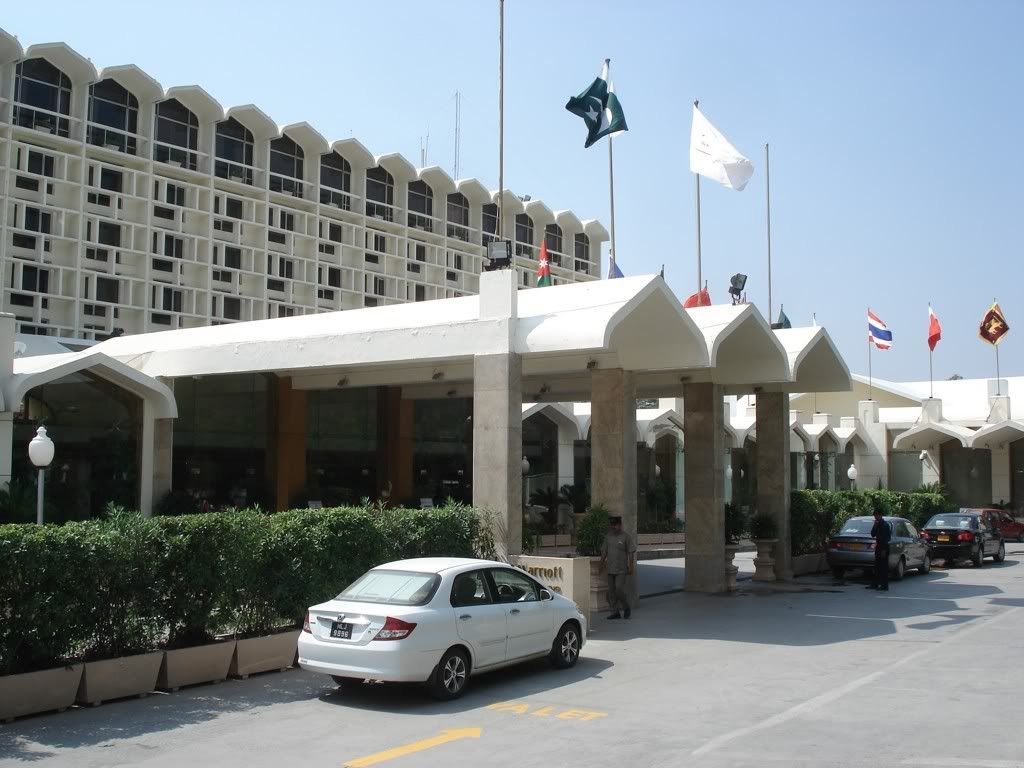
Marriot Hotel bomb, Islamabad, Pakistan

Just a short aside from landslides. In January 2006 I attended a conference organised by the Geological Survey of Pakistan. The theme was to gain an understanding of the lessons learnt from the Kashmir earthquake - the proceedings are available online here. The conference was fascinating but desperately sad as speaker after speaker showed images of the destruction associated with the earthquake.


Today the Marriott hotel was senselessly bombed and destroyed, with dozens of fatalities. IThis is a desperately tragic event both for those involved and for Pakistan. I hope that those injured are able to recover as soon as possible. The reality of this event feels very real to me as we had been due in Pakistan this month to provide hazard mapping training. We were scheduled to stay in the Marriott in Islamabad. We postponed because of issues around timing with respect to Ramadan. I feel very fortunate tonight.