Thanks to Greg Stock for bringing this one to my attention. Yosemite National Park have produced a video providing information for visitors about the hazards associated with rockfalls. It includes an extraordinary piece of footage - captured by a visitor to the park - of a rockfall detaching from the cliff, fragmenting on impact on the the slope, and then travelling down the talus slope. The video of the detachment event is fantastic - I have never seen anything as good. However, the rest of the video is great as well, and will be very valuable to those trying to provide improved awareness rockfalls in many environments. The video should be viewable below (click on read more to see the rest of the post):
Or you can view it here: http://www.youtube.com/watch?v=H0YhlqP1BgE
Showing posts with label rockfall. Show all posts
Showing posts with label rockfall. Show all posts
Friday, August 27, 2010

Tuesday, July 20, 2010
New rockfall video from India
A good new rockfall video has been posted on Youtube, collected in the Pangi Valley of Himachal Pradesh in India:
Monday, April 12, 2010
Toyota Yaris vs rock...
The Mirror newspaper in the UK yesterday carried a dramatc illustration of the effect that a boulder can have on a car. This car was parked by the side of the road in Hayfield in Derbyshire on Sunday when an eight tonne boulder slipped off a lorry. Fortunately there was no-one in the car:


Time to buy a new bottle of T-cut? Picture from the Mirror
Wednesday, March 24, 2010
Tuesday, January 26, 2010
Fatal rockfall near to Munich in Germany

Last night a fatal rockfall occurred at Stein an der Traun in Southern Bavaria. According to this report, which is also the source of the remarkable image above, the block was the "size of a house" (probably something of an over-estimate), falling from the 15 m slope behind the building. There were four people in the house at the time, of which two were killed and two were injured. There is no obvious trigger for the failure.
It is of course too early to speculate about the causes of this sad accident, but in my experience the combination of an unfortunately-orientated discontinuity in the rock (often a joint) and cutting of the toe of the slope to create space for the building are often to blame. It will be interesting to find out what caused this accident.
Thursday, January 7, 2010
Angler killed in rockfall in NE England
The BBC is reporting that an an angler was killed in a landslide last night in Sandy Bay, near Newbiggin-on-Sea in Northumberland, NE. England. He was reportedly standing at the top of a 15 m high cliff that collapsed, killing him when he fell.
This is Sandy Bay:

This is Sandy Bay:

Tuesday, November 17, 2009
Now that is what I call a boulder!
Thanks to Dr Kurt Douglas at the University of New South Wales for drawing my attention to this. The Australian Courier Mail has a story today about a family that survived a near miss from a 1500 tonne boulder that rolled from the hill above their house in southern Queensland on Friday. The rock detached from the slope above their house and rolled to within 50 m of their property at 3 am. All this sounds quite unremarkable until you see the pictures of the boulder:
 And the source:
And the source:
Sunday, November 1, 2009
Another fatal beach rockfall - this time in Spain
In August this year a rockfall on a beach in Portugal killed five people and injured four others. Unfortunately the newspapers in the UK are this evening reporting that a similar rockfall occurred today on a beach at Playa de los Gigantes in western Tenerife in Spain, killing a British woman and a local woman. The Telegraph has a report and picture (below) of the incident:

Coastal cliffs unfortunately are prone to erosion and thus to rockfalls. News reports suggest that access to this section of beach had been blocked due to an earlier event. Sadly, many people do not seem to appreciate that rockfalls can occur at any time , including in good weather.

Coastal cliffs unfortunately are prone to erosion and thus to rockfalls. News reports suggest that access to this section of beach had been blocked due to an earlier event. Sadly, many people do not seem to appreciate that rockfalls can occur at any time , including in good weather.
Friday, September 18, 2009
Extraordinary! Using a helicopter sledgehammer to clear loose rock from a cliff!

I thought I had seen everything until I saw this video! It is from Norway, showing an extraordinary method for removing a loose rock pillar from a high, steep cliff. The answer is obvious - just hang a 1.8 tonne block on a cable under the helicopter and bash the offending rock with your new sledgehammer. This must take very skillful flying. The most amazing thing is that it worked - and there is some good footage of the not - insubstantial block descending the cliff.

I really strongly advise that you take look! It is on the following Norwegian news site:
http://www.adressa.no/tv/?id=11756
Friday, September 4, 2009
The Cikangkareng village landslide, Indonesia
As I reported a couple of days ago, the Mw=7.0 earthquake in Indonesia on Wednesday triggered a substantive landslide in the village of Cikangkareng in West Java. This landslide buried ten houses, a mosque and an amusement (video game) arcade with the loss of about 57 lives. AP have today released images of the landslide that are quite interesting. In particular this one:  In that case the key cause was probably quarrying at the foot of the slope.
 Why is this interesting? Well, first lets note that we should ignore the red colour on the face of the scarp - this is a mantle of tropical soil that have come down from the crown of the slide (you can see the red soil at the very top of the landslide - this is of course typical of a tropical area). More important is the structure behind the mantle of soil debris. Here it is clear that the rocks are horizontally-bedded (or at least nearly so). Such a large failure in horizontally-bedded rocks is certainly not unprecedented, but is slightly surprising. The debris is very coarse-grained and has travelled quite a long way, which is also interesting.
Often, failures like this are associated with some process that has caused undercutting of the toe - for example wave erosion. Clearly there are no waves here - I wonder if there had been any activity to quarry stone from the slope, perhaps as a building material?
I am reminded of the Manshiet Nasser landslide in Cairo a year ago:
In that case the key cause was probably quarrying at the foot of the slope.
Tuesday, April 14, 2009
A round-up of some recent landslide events
I thought that it was time to provide a round-up of some landslide events from around the world:
1. A narrow escape in Australia
Thanks to Remke van Dam for bringing this one to my attention. This Australian family had a pretty lucky escape last week when a pair of large rocks struck their car (image from here):

2. A road-blocking rockfall in Alaska
Thanks to John Fritz for this one. In Alaska, a pretty large rockfall has blocked the Whittier tunnel (see news report here):

The landslide occurred on Saturday; the road is expected to be blocked until Wednesday.
3. A fatal landslide in Idaho
In contrast to the first item above, a very unlucky couple were killed by a landslide in Idaho last week. According to this report, the couple's 4x4 (SUV) was hit by a tree that had toppled onto the road as a result of a small landslide near to Orofino. As the image below (from here) shows, the tree hit the cab, killing the occupants:

1. A narrow escape in Australia
Thanks to Remke van Dam for bringing this one to my attention. This Australian family had a pretty lucky escape last week when a pair of large rocks struck their car (image from here):

2. A road-blocking rockfall in Alaska
Thanks to John Fritz for this one. In Alaska, a pretty large rockfall has blocked the Whittier tunnel (see news report here):

The landslide occurred on Saturday; the road is expected to be blocked until Wednesday.
3. A fatal landslide in Idaho
In contrast to the first item above, a very unlucky couple were killed by a landslide in Idaho last week. According to this report, the couple's 4x4 (SUV) was hit by a tree that had toppled onto the road as a result of a small landslide near to Orofino. As the image below (from here) shows, the tree hit the cab, killing the occupants:

Monday, April 6, 2009
Cave rockfall in Shropshire, England
The British newspapers are reporting that overnight a rockfall occurred in Hermitage Cave near to Bridgnorth in Shropshire, England. This is news because at the time there was a group of teenagers camping in the cave. Sadly, one of them was killed and another was badly injured. These caves are old dwellings cut into the Bridgnorth Sandstone (see image below from here):
 The caves used to be much larger but rockfalls over time have progressively reduced their extent. There are reports that the ill-fated group lit a fire in the cave. I must stress that this is unconfirmed. Sometimes however falls like this are triggered by campfires lit in the cave, which induce thermal stresses in the ceiling that trigger the collapse. I am not sure if this is the case here - it could well be that the group were just very unlucky indeed - but fires in caves with low ceilings can be a quite significant hazard. Sadly, it is very unlikely that the group would have known about that particular danger.
 The caves used to be much larger but rockfalls over time have progressively reduced their extent. There are reports that the ill-fated group lit a fire in the cave. I must stress that this is unconfirmed. Sometimes however falls like this are triggered by campfires lit in the cave, which induce thermal stresses in the ceiling that trigger the collapse. I am not sure if this is the case here - it could well be that the group were just very unlucky indeed - but fires in caves with low ceilings can be a quite significant hazard. Sadly, it is very unlikely that the group would have known about that particular danger.
Tuesday, March 31, 2009
Yosemite rockfall - seismic signal
Improvements in the quality of seismic monitoring systems, in addition to increases in the numbers of instruments and better processing techniques have meant that in the last few years it has become increasingly common to detect large rockfall events from their seismic signature. A nice example of this occurred this week. On 28th March a large rockfall occurred from Ahwiyah Point near Half Dome in Yosemite. This is a pretty large lump of granite:
 (Image from http://wikimapia.org/1881070/Ahwiyah-Point)
There is a very nice image of the rockfall scar and track available on Flicker, but it is not possible to import the file. Take a look. This is a less good image from the National Park Service - you do get a pretty good idea of what was involved:

The National Park Service description of this event is as follows:
"[the rocks] fell roughly [600 m] to the floor of Tenaya Canyon, striking ledges along the way. Debris extended well out into the Canyon, knocking down hundreds of trees and burying the southern portion of the Mirror Lake loop trail." They are also reporting that there was a small air blast, but no-one was killed.
Of course, seismic monitoring in the part of the USA is a bit of a fine art, so it is unsurprising that the event was picked up on multiple instruments. There is a nice image on Seismoblog of the recorded seismic events from a range of instruments located an increasing distance from the site:

Based on the sesmic data the USGS were quickly able to locate the fall - pretty impressive!
 (Image from http://wikimapia.org/1881070/Ahwiyah-Point)
 There is a very nice image of the rockfall scar and track available on Flicker, but it is not possible to import the file. Take a look. This is a less good image from the National Park Service - you do get a pretty good idea of what was involved:

The National Park Service description of this event is as follows:
"[the rocks] fell roughly [600 m] to the floor of Tenaya Canyon, striking ledges along the way. Debris extended well out into the Canyon, knocking down hundreds of trees and burying the southern portion of the Mirror Lake loop trail." They are also reporting that there was a small air blast, but no-one was killed.
Of course, seismic monitoring in the part of the USA is a bit of a fine art, so it is unsurprising that the event was picked up on multiple instruments. There is a nice image on Seismoblog of the recorded seismic events from a range of instruments located an increasing distance from the site:

Based on the sesmic data the USGS were quickly able to locate the fall - pretty impressive!
Terrific rockfall resource
The Colorado Geological Survey publishes a terrific quarterly newsletter on "all aspects of geology throughout the state of Colorado. The latest edition, which is available online for free from here, focuses on rockfalls. It is a terrific read, with some very interesting articles on how and why rockfalls happen; how they can be detected; mitigation approaches; and a number of case studies. It is illustrated with some great photos as well. My favourite two, showing the range of scales of hazardous rockfalls:


And this "spot the difference" is rather nice too. The images were taken about 120 years apart:


And this "spot the difference" is rather nice too. The images were taken about 120 years apart:

Thursday, March 5, 2009
Karst landslide in China
Xinhua is reporting a landslide in Jinjiling Hill in Guilin, Guangxi yesterday that buried several houses and killed four people. Whilst in global terms the event was not huge, the images that Xinhua have published are quite interesting:

Xinhua describes the event thus: "...several hundred tonnes of rocks and dirt gushed down from the mountain at about 9:20 p.m. Wednesday. Four workers in charge of a cave-digging project in the hill, the project contractor and his wife were in the houses when the accident took place, the city's public security bureau said. Jiang Mingyi, head of the city's geological environment monitoring station, said ongoing rain over the past few days triggered the landslide and the local karst-landform is prone to mountain collapse in the rainy season."
It would be easy to ascribe this collapse to the caving digging work that was going on at the toe of the slope. However, the failure appears to have occurred on an unfavourably orientated joint high up on the slope. The initial collapse was possibly quite small, but the failure has accrued debris on the way down to create quite a large failure. Thus, the interpretation that the failure was rainfall-induced looks spot on.
Of course, what is not clear is the degree to which the work at the toe of the slope disturbed the joints upslope. If blasting was being used this is of course quite possible.

Xinhua describes the event thus: "...several hundred tonnes of rocks and dirt gushed down from the mountain at about 9:20 p.m. Wednesday. Four workers in charge of a cave-digging project in the hill, the project contractor and his wife were in the houses when the accident took place, the city's public security bureau said. Jiang Mingyi, head of the city's geological environment monitoring station, said ongoing rain over the past few days triggered the landslide and the local karst-landform is prone to mountain collapse in the rainy season."
It would be easy to ascribe this collapse to the caving digging work that was going on at the toe of the slope. However, the failure appears to have occurred on an unfavourably orientated joint high up on the slope. The initial collapse was possibly quite small, but the failure has accrued debris on the way down to create quite a large failure. Thus, the interpretation that the failure was rainfall-induced looks spot on.
Of course, what is not clear is the degree to which the work at the toe of the slope disturbed the joints upslope. If blasting was being used this is of course quite possible.
Friday, January 30, 2009
Some interesting landslide sites
I thought that it was high time to post a summary of some interesting landslide sites:
Aowanda landslide
There is an interesting youtube video of a smallish progressive rockslide occurring at Aowanda in Taiwan here. It should also be visible below:
Not quite as dramatic as some others, but useful nonetheless.
Five disastrous landslides that changed the Canadian Landscape
There is quite a nice non-scientific piece here that describes in non-technical language five large and significant historic landslides in Canada over the last century or so. Good images!
Rockfall blog
There is an interesting new blog here that looks at measures that can be used to prevent rockfalls. Although it is in Italian, Google Language Tools do a pretty good job of translating the text. I guess one should be a little careful of the fact that it is promoting a company, but there is some nice stuff there.
The largest known landslide?
National Geographic has a nice story here that speculates that a large deposit on Mars might be the debris from a landslide that would have been the size of the United States. Working on Mars must be great because no-one can check your interpretation with field data.
Flashflood footage
It is a fine line between a debris-rich flash flood and a debris flow, so I thought that I would highlight this youtube video of a flash flood in Australia. The first minute isn't terribly exciting, but stick with it! It should be visible below:
Extraordinary video of the Baldwin Hills dam disaster
There is an excellent video of the collapse of the Baldwin Hills dam in 1963 on youtube here. This is a great illustration of the dangers associated with the formation and collapse of landslide dams. Again, it should be visible below:
Aowanda landslide
There is an interesting youtube video of a smallish progressive rockslide occurring at Aowanda in Taiwan here. It should also be visible below:
Not quite as dramatic as some others, but useful nonetheless.
Five disastrous landslides that changed the Canadian Landscape
There is quite a nice non-scientific piece here that describes in non-technical language five large and significant historic landslides in Canada over the last century or so. Good images!
Rockfall blog
There is an interesting new blog here that looks at measures that can be used to prevent rockfalls. Although it is in Italian, Google Language Tools do a pretty good job of translating the text. I guess one should be a little careful of the fact that it is promoting a company, but there is some nice stuff there.
The largest known landslide?
National Geographic has a nice story here that speculates that a large deposit on Mars might be the debris from a landslide that would have been the size of the United States. Working on Mars must be great because no-one can check your interpretation with field data.
Flashflood footage
It is a fine line between a debris-rich flash flood and a debris flow, so I thought that I would highlight this youtube video of a flash flood in Australia. The first minute isn't terribly exciting, but stick with it! It should be visible below:
Extraordinary video of the Baldwin Hills dam disaster
There is an excellent video of the collapse of the Baldwin Hills dam in 1963 on youtube here. This is a great illustration of the dangers associated with the formation and collapse of landslide dams. Again, it should be visible below:
Monday, November 24, 2008
Quarry rockfall in Guangxi
ChinaDaily is carrying the image below of an large rockfall in a former quarry in Fengshan County of Guangxi Province in China:

The accompanying report says that the landslide occurred without warning and without an obvious trigger in a long-abandoned quarry. The volume of the landslide is reported to be 21,000 cubic metres. It buried 300m of road, 16 buildings, two tractors, a car and a motorbike. Sadly, five people were killed, one person is reported missing and six people were injured, two seriously.
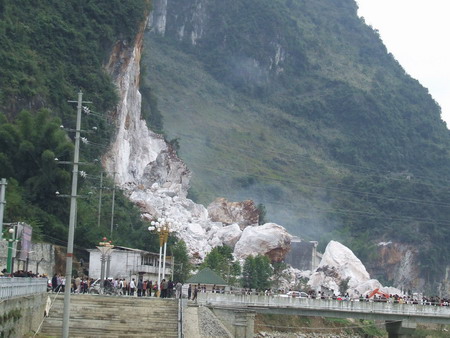
The accompanying report says that the landslide occurred without warning and without an obvious trigger in a long-abandoned quarry. The volume of the landslide is reported to be 21,000 cubic metres. It buried 300m of road, 16 buildings, two tractors, a car and a motorbike. Sadly, five people were killed, one person is reported missing and six people were injured, two seriously.
Monday, October 27, 2008
Rockfall sequence in Yosemite
Geology.com has a spectacular sequence of images of a rockfall in progress in Yosemite National Park that are well worth a look. The images (which are explicitly copyrighted, so I have not reproduced them here) were collected by a well-known photographer, Herb Dunn, in the canyon of the Merced River.
The pictures show a fall from what appears to be a previously active rockfall scar. Below the scar there is a large area of rockfall debris. The falls appear to occur in granitic rocks, with the detachment being controlled by a series of large joints.
The failure in this case was apparently quite large - the bock was 30 m x 15 m - and appears to have come from a wedge failure at the top of the scar. As a result of the large fall height and substantial volume, the boulders have fragmented as they have impacted the slope, creating a spectacular plume of dust that rolls downwards. The rocks also disturb the accumulated and weathered scree that they hit, which means that the dust cloud starts to change colour in the third image as the discoloured material is kicked up. The fifth image captures some airborne blocks (see the bottom of the image in the centre), which are quite impressive.
Note that the failure has happened on a beautiful sunny day in August, so the trigger mechanism is not really obvious (thermal expansion maybe, or perhaps just progressive failure).
The pictures show a fall from what appears to be a previously active rockfall scar. Below the scar there is a large area of rockfall debris. The falls appear to occur in granitic rocks, with the detachment being controlled by a series of large joints.
The failure in this case was apparently quite large - the bock was 30 m x 15 m - and appears to have come from a wedge failure at the top of the scar. As a result of the large fall height and substantial volume, the boulders have fragmented as they have impacted the slope, creating a spectacular plume of dust that rolls downwards. The rocks also disturb the accumulated and weathered scree that they hit, which means that the dust cloud starts to change colour in the third image as the discoloured material is kicked up. The fifth image captures some airborne blocks (see the bottom of the image in the centre), which are quite impressive.
Note that the failure has happened on a beautiful sunny day in August, so the trigger mechanism is not really obvious (thermal expansion maybe, or perhaps just progressive failure).
Tuesday, September 16, 2008
Loss of life in the China and Egypt landslidesp
Just a brief update on the latest estimate of the loss of life in the landslides last week in Egypt and China:

Taoshi (Shanxi): as of 16th September the official death toll is 259 people. Searches continue (see above AFP image).

Manshiet Nasser (Cairo): as of 16th September the official death toll is 92 people. It appears that recovery actions have now ceased as the site is considered to be too dangerous. There are likely to be many victims still buried. It is difficult to see how recovery operations can be safely undertaken under blocks such as the above (Reuters image).

Taoshi (Shanxi): as of 16th September the official death toll is 259 people. Searches continue (see above AFP image).

Manshiet Nasser (Cairo): as of 16th September the official death toll is 92 people. It appears that recovery actions have now ceased as the site is considered to be too dangerous. There are likely to be many victims still buried. It is difficult to see how recovery operations can be safely undertaken under blocks such as the above (Reuters image).

Sunday, September 14, 2008
Loss of life in the Manshiet Nasser (Cairo) and Taoshi township (Shaanxi) landslides
Xinhua is now reporting that the death toll in the Shaanxi landslide has now reached 254. They also report that the recovery teams are yet to search two channels in which local people believe more bodies are buried
AFP is reporting that the number of fatalities in the Manshiet Nasser (Cairo) landslide is now 82 people, with at least another week of recovery work to follow. Interestingly. they also report that "Residents have blamed the rock slide on work that had been going on for several weeks on the Moqattam hill overlooking the shantytown". It would be interesting to find out more about this work.
AFP is reporting that the number of fatalities in the Manshiet Nasser (Cairo) landslide is now 82 people, with at least another week of recovery work to follow. Interestingly. they also report that "Residents have blamed the rock slide on work that had been going on for several weeks on the Moqattam hill overlooking the shantytown". It would be interesting to find out more about this work.
Subscribe to:
Posts (Atom)