Tuesday, January 6, 2009

The Guatemala landslide was caught on video!

Unbelievably, it turns out that the Guatemalan landslide, which it appears killed at least 42 people, was caught on video. Geologist Marlon Contreras was recording at the edge of the site when the failure occurred. The video captures the movement, although mercifully little of the detail. The video can be viewed at this web page:

http://www.prensalibre.com/pl/2009/enero/06/multimedia.html


The failure that happens 1 minute and 50 seconds into the video defies belief! I urge you to take a look at the video.


Meanwhile, and quite rightly, rescue operations have been halted due to the dangers of continued falling rocks to the rescuers. Given that there is no possibility of any survivors this has to be the right decision, harsh though it undoubtedly is.

Finally, there is still a huge variation in the reported number of victims. Prensa Libre is reporting that 42 people were affected, but other news agencies suggest that it might be double this total, or even more.

The Tennessee flow slide accident - what went wrong?

The fallout from the recent flowslide accident at the Tennessee Valley Authority's (TVA) Kingston power plant in the USA on 22nd December, which I highlighted here, continue. There is an increasing sense that this was an unacceptable failure (it is hard to argue with that) and that it was lucky that there was not a loss of life in the accident.

This AP image is a good starting point as it is much clearer from this as to what has happened:

Perhaps the most useful resource though is this article from the www.tennessean.com, which I thoroughly recommend. It provides an excellent interpretation of what happened in the lead up to the accident. They have provided two aerial images of the site, before:

And after:


The gist of the article is as follows:
  1. The failure occurred on a 20 m high embankment constructed primarily from ash blocks that collected in the base of the plant's burners. The fly ash is deposited into the lagoon in a wet state;
  2. In November 2003 the lagoon suffered from a blow out (failure) caused by piping and seepage (i.e. water starts to flow through the ash, which then induces erosion. This then allows a pipe to form, which collects, channels and accelerates the flow, allowing erosion to intensify. This can rapidly create a weak zone);
  3. In December 2003 a mitigation scheme was proposed, consisting of "a series of trench drains at different levels on the dike, another drain at the base of the mound and a riprap (i.e. armoured) channel."
  4. This mitigation scheme was completed in October 2005
  5. In 2006 a further failure occurred, with a 1.5 x 1.5 m section failing through seepage, releasing some ash;
  6. This section was repaired and wells were installed behind the embankment, presumably to lower water pressure, monitored using 30 shallow piezometers;
  7. The article mentions that the embankment was inspected and passed in a report produced on 15th February 2008 and found to be stable, but that "plant operators were commended for mowing the landfill slopes. Trees too large to be mowed should be cut, the stumps removed, the area backfilled with soil and seeded". "They mentioned small trees being removed," said Tschantz, the dam safety consultant. "I'm wondering if trees had a role to play. You don't just pull those things out. The root channels have to be filled and compacted."
In December 2008 the site received 125 mm of rainfall (the average for December is 70 mm). Failure occurred on 22nd December.

Clearly it is far too early to identify exactly what has gone wrong or who, if anyone, is to blame. The key issues must be to clear up the mess and to learn the lessons, especially if there are other sites that are also vulnerable to failure. One suspects that the costs of this incident will be very high indeed - far more than the cost of constructing a safe embankment in the first place.

I do recommend the article (here) - it appears to be a good piece of journalism.

As an aside, it appears from the images that sections of the embankment have been moved intact (see image below - these can also be seen in the photo at the top of this post):

The sides of the embankment also appear to have failed (marked "lateral failure?" above). This suggests to me that pore pressures in the ash were very high indeed. I wonder if a factor here is the use of ash in the embankment as its comparatively low density might have made the embankment rather vulnerable to failure due to high buoyancy forces.

Monday, January 5, 2009

December 2008 landslide map

I am just in the process of putting together my annual collation of fatal landslide statistics for 2008, together with the map of all the landslides, but in the meantime here are the statistics and map for December.

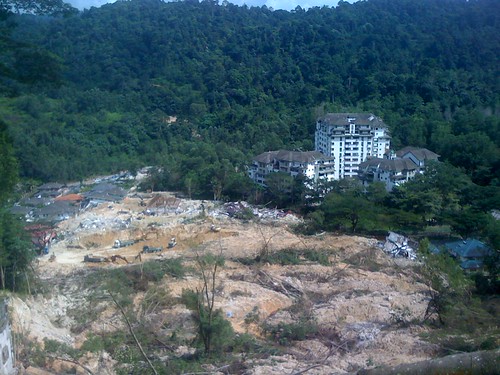
So first the data. I recorded a total of 16 fatal landslides in December, causing 46 fatalities. This is well below the long term average, which 149.8 fatalities. The largest event was the Kainantu Mine landslide in Papua New Guinea on 4th December, which killed 10 people. I guess the highest profile event was the Bukit Antarabangsa landslide near to Kuala Lumpur, which killed five people on 6th December. This has really dominated the news in Malaysia since.

Here is the map. You will see that I have taken the "copyright" statement off to make it more usable. Please do acknowledge this blog if you use it in presentations etc, and please don't publish it without my permission. Click on the map for a better view:


As mentioned above I will provide a proper commentary for the 2008 dataset in due course (might take a week or two), but in the meantime here is the provisional final map for 2008. As before, click on the map for a better view:

Comments and/or corrections welcome. One of my tasks for this year is to get a better mapping program than Versamap (suggestions welcome)...

Guatemala landslide update: 33 killed and up to 70 people reported missing

A short update on the Guatemala landslide, which is looking like a dreadful tragedy.

Diaro de Centro America has published this dramatic image of the site:


Meanwhile Prensa Libre is reporting that the number of people killed is now known to be 33, with more people still missing. Telediaro suggests that the number missing may be as high as 70 people! Landslides are continuing to hamper the rescue operations.

Guatemala landslide

The first major landslide event of 2008 occurred on Sunday in Alta Verapaz in northern Guatemala. At the moment reports are somewhat fragmented, but the Guatemalan newspaper Prensa Libre has published the following (not great quality) image. I have tried to enhance it as much as I can:

Clearly this is a major failure - the news report suggests a mass of10,000 tonnes. To date that there are 29 known fatalities plus 15 people reported injured. It appears that there are concerns that the death toll may be much higher as there were 140 people on the road at the time of the failure.

In fact the Prensa Libre report is impressive in terms of the level of geological detail that they provide - far better than is usually the case. A number of key issues emerge:
  1. This same stretch of road suffered a landslide on 14th December that killed two people;
  2. It was known that another failure was likely, such that the road had been closed. The 140 potential victims appear to have disobeyed instructions when they walked across the affected section;
  3. The landslide has occurred in an area that is traversed by a known fault, which has weakened the ground and caused water seepage;
  4. Further failures are feared.
For info the failure appears to have occurred somewhere on the section of road shown below, although the Google Earth image is not good enough to pinpoint its likely location properly (click on the image for a better view):


I will post more as details become available.

Friday, January 2, 2009

Evaluating coastal erosion using art

The BBC is carrying a quite interesting story at the moment about the use of artwork from the nineteenth century to evaluate rates of coastal erosion. The story originates from Robin McInnes, who is an established figure in coastal management. Robin was the Coastal Manager for the Isle of Wight, in southern England for many years, during which he led the way in terms of developing an understanding and management of coastal erosion. This ended somewhat abruptly a couple of years ago. Fortunately, Robin is clearly still active in an independent capacity.

The work has been written up in a short but useful report that is available here. There was also a New Scientist article that featured this approach in the middle of last year.

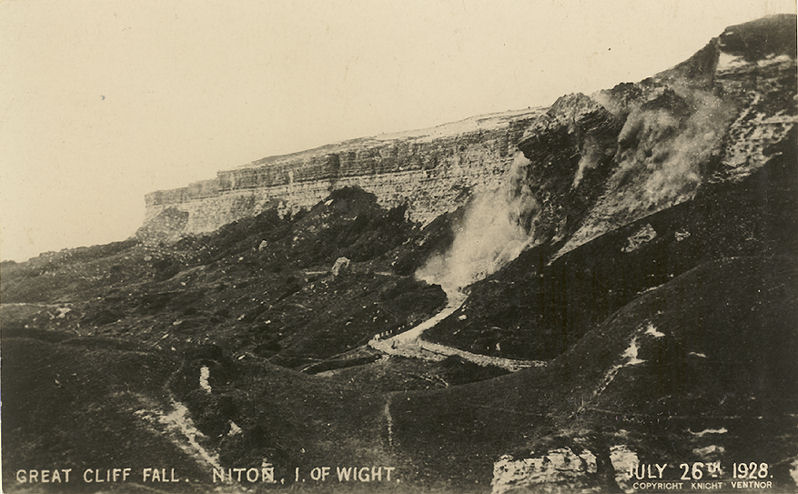
The Isle of Wight is well known as a zone of active coastal erosion, most notably as a result of a series of large landslides along the southern coast, including probably one of the earliest events captured on camera:

Fortunately, the south coast of the Isle of Wight is also both beautiful and accessible. It was a particularly fashionable tourist destination of the rich and famous in Victorian (mid to late 19th century) times, which meant that it was also frequently captured in artwork. Robin McInnes has amassed over 400 pieces of artwork from the period 1770 onwards. He has graded the quality of depiction of each artist in order to determine which provides a representation that is sufficiently reliable to be usable today. McInnes suggests that good quality depictions can be used to:
  • Understand geological structure and form (especially where the artists depicted a landscape that has now been built over or forested);
  • Examine changes in geomorphological structures or processes;
  • Determine changes in beach geometries;
  • Compare changes in coastal morphology due to erosion;
  • Provide a chronology of coastal defences;
  • Establish the evolution of estuaries and harbours;
  • Provide an insight into habitat change.
An example of the way that this type of approach can be used is as follows. The first image below is a painting that McInnes highlights. It is called ‘Ventnor Cove’ and was painted in 1825 by Charles Raye.


The image below is a photograph from the 1890's of Steephill Cove in Ventnor (from here):


Here is a photograph of Steephill Cove from 1906 (from here):


And finally, here is a modern day image (from here):

Thursday, January 1, 2009

Malaysia landslide - residents action group blog

I have only briefly touched upon the 6th December 2008 landslide at Bukit Antarabangsa in Kuala Lumpur, which has been a very high profile event in Malaysia. I don't intend to comment on any aspect of the landslide - GiB has covered it in his own style in the oddly-named Landslide under Microscope blog - see here, here and here. Interestingly though a new Blog has appeared called Save Bukit Antarabangsa, which is a "voice of residents and owners" - essentially an online newspaper for a residents action group.

There is also quite an interesting blog by a resident, Yen Hee, who is working to help the community to recover. The blog is here.